

- Opening space to private players has helped cut brain drain
- Private startups, including Skyroot, are creating jobs for young engineers
- India's space economy is around USD 9 billion, per Dr Jitendra Singh
- Satellite data is helping Nepal, Bangladesh, Myanmar and Sri Lanka prepare for floods
- Dr Jitendra Singh urged students to use AI while keeping independent thinking
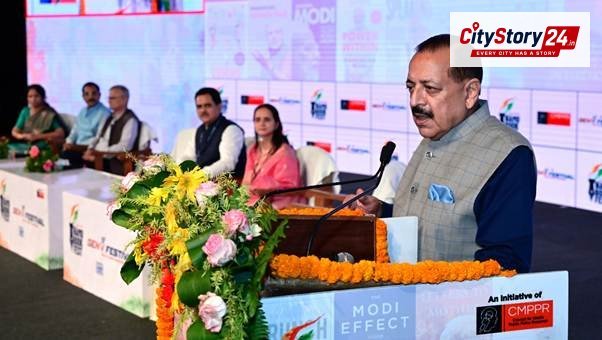
Opening the space sector to private players has reduced the need for young Indian scientists to work abroad, Dr Jitendra Singh said in Varanasi.
He was speaking to students at the NaMo Book Fest at the Rudraksh International Cooperation and Convention Centre. The two-day festival runs on October 7-8.
Startups keep talent at home
Earlier, young professionals often looked overseas because domestic opportunities were limited. Dr Singh said the opening of the sector now lets more of them stay and contribute.
He named private space startups, including Skyroot, as creating new openings for engineers in India.
He said the sector had moved from a largely government-led domain to a wider ecosystem. Government bodies, industry, startups, academia and research institutions must work together, he added.
“The age of silos is over,” Dr Jitendra Singh said.
He said the space economy has reached around USD 9 billion. If current momentum continues, it could reach USD 45-46 billion in the next 8-10 years.
Space beyond rockets
Dr Singh told students that space technology now helps in everyday life. Its uses include infrastructure planning, project monitoring and disaster management.
Indian satellites are also giving information to Nepal, Bangladesh, Myanmar and Sri Lanka. The data helps them prepare for floods and other disasters, he said.
Science push and the AI message
He described the last 12-13 years as an “Era of Science” in India. Technology now gets high policy priority, he said, and the policy environment has strengthened in recent years.
He cited the Deep Ocean Mission, the Quantum Mission, Artificial Intelligence, Cyber Security and the Anusandhan National Research Foundation. He also pointed to the Genome India initiative and India’s biotechnology policy framework.
On Artificial Intelligence, he urged students to use the technology while keeping independent thinking and curiosity. “You have to be intelligent enough to use Artificial Intelligence,” he said.
Dr Singh also said the nuclear sector is now open to private participation. India targets 100 GW of nuclear energy capacity by 2047.
He said India has moved from following the world in science to moving alongside it. He said the next phase will depend on sustained collaboration and greater opportunities for young talent.