

Source: Press Information Bureau (PIB), Government of India — Ministry of Electronics and IT · PIB Delhi · Read the original release on pib.gov.in
- Scientific conference on digital innovations in nursing practice organized as part of MNS centenary year celebrations
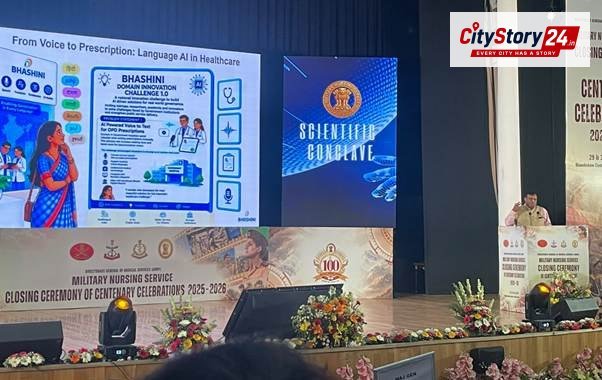
Military Nursing Service (MNS) In his Manekshaw Center located in Delhi Cantt. centenary year 2026 As part of the closing ceremony of “Digital Innovation in Nursing Practice: Reconciling Technology and Compassionate Care” Organized a scientific conference on the subject. The conference was attended by senior leadership, nursing professionals, health care practitioners and technology sector stakeholders to deliberate on the emerging role of digital innovation in strengthening health care delivery and nursing practice.
Mr. Amitabh Nag, CEO, speaker, at the opening ceremony of the scientific conference on keynote speaker where he “Technology in Health: The Scope of Digital Health Opportunities in Transforming the Health Care Landscape” Gave the keynote address titled.
General Dheeraj Seth, PVSM, UYSM, AVSM, Chief of the Army Staff, was the Chief Guest of the inaugural ceremony. MNS Diary and Nursing Research Compendium were also released in the program and “Digital Pulse of Nursing: Connecting Technologies, Transforming Care” E-release of scientific souvenir titled
In his keynote address, Shri Nag highlighted the transformative potential of digital technologies in healthcare and emphasized that language, context and healthcare-specific data are essential to building technology that is accessible, accurate and responsive to the needs of patients and healthcare professionals.
He explained the four pillars of speech and language and its growing role in health care, including speech, translation and other language technologies. These technologies can reduce communication barriers and make health care systems more inclusive in the diverse linguistic landscape of India.
He stressed the need to develop medical and nursing terminologies as foundational language resources for AI systems focused on health care. Uniformity in medical terminology is essential, as patients often describe symptoms in everyday language and the same condition may be expressed differently in different languages, regions and contexts. Therefore, AI systems require health care-specific language data to accurately understand this diversity. A well-developed glossary can connect clinical terminology to everyday language, creating a shared language level between health care professionals, patients, and AI systems.
Mr Nag also underlined the importance of language in providing care. Since health care communication occurs in diverse linguistic and social contexts, language, datasets, digital literacy, and clinical accuracy are critical for effective adoption of digital health technologies.
He worked in health care Bhashini Domain Innovation Challenge , which encourages technology-based solutions to practical challenges in health care communication. The solutions presented also included an AI-powered voice-to-text tool for OPD prescriptions, demonstrating how speech and language technologies can aid clinical workflow and enable more effective documentation. He highlighted the potential of voice-first and multilingual technologies to bridge the gap between technology and the realities of health care delivery, particularly in cases where communication must move seamlessly between clinical terminology and the language used by patients.
Speaking about language in compassionate health care, Mr. Nag said, “Context is important, Care is important, Compassion is important and in health care, These three become even more important, “When we are communicating with people in a language they understand.”
Discussions at the scientific conference reflected the growing intersection of nursing, health care, digital technologies and AI, emphasizing the need to integrate technological advances with the human aspects of care.
The participation of Bhashini CEO at the MNS Centenary Scientific Conference underlined the importance of building digital health solutions that take into account India's linguistic diversity and support healthcare professionals and patients through technologies that are accessible, context-aware and tailored to real-life communication needs.
The scientific conference was an important part of the Military Nursing Service's centenary celebrations, commemorating a century of dedicated service and recognizing the evolving role of nursing in an increasingly technology-enabled health care ecosystem.
About Digital India Language Division (DIBD)
Digital India Language Division (DIBD), under Digital India Corporation (DIC), Ministry of Electronics and Information Technology (MeitY), is India's national platform for AI-powered multilingual digital inclusion. Bhashini powers over 800 government websites, has enabled over 9 billion cumulative AI inferences, processes over 24 million AI inferences per day and supports 36 Indian text languages, 23 Indian voice languages and 35 international languages, enabling greater accessibility to digital services through Language AI.
This is the official press release issued by the Press Information Bureau (PIB), and is published without changes.