
Source: Press Information Bureau (PIB), Government of India — Ministry of Corporate Affairs · PIB Bengaluru · Read the original release on pib.gov.in
The National Company Law Tribunal (NCLT) has approved 107 Resolution Plans during the second quarter of Financial Year 2026–27, recording the highest number of Resolution Plans approved in any quarter since the inception of the Tribunal. The figure is also the highest number of Resolution Plans approved in any second quarter since the NCLT was established.
The performance represents a significant improvement over the corresponding quarter of previous years. The NCLT had approved 60 Resolution Plans in the second quarter of FY 2025–26, 57 in FY 2024–25, 82 in FY 2023–24, 47 in FY 2022–23 and 20 in FY 2021–22. The present quarter’s figure of 107 is therefore the highest quarterly performance recorded by the Tribunal.
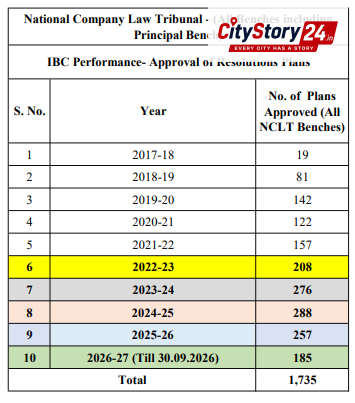
The 107 Resolution Plans approved during the quarter involved an aggregate approved plan value of more than ₹11,000 crore. Together with 78 Resolution Plans approved during the first quarter of the current financial year, the Tribunal has approved 185 Resolution Plans during the first half of FY 2026–27. The cumulative number of Resolution Plans approved by the NCLT across its Benches has consequently reached 1,735 as on 30 September 2026.
The Tribunal has maintained this performance alongside the continuing filing of applications seeking approval of Resolution Plans. On 29 April 2026, the Hon’ble Supreme Court, while considering the issue of delays in approval of Resolution Plans, had noted that 363 applications were then awaiting approval before the NCLT. As on 30 September 2026, 294 Resolution Plans were pending consideration for approval, while orders had been reserved in respect of a further 41 Resolution Plans. Thus, 335 matters were at these two stages as on that date. This represents a reduction in the number of applications awaiting approval when compared with the position noted by the Hon’ble Supreme Court in April 2026.
The improvement in performance has been accompanied by a series of administrative and institutional measures undertaken in recent months to strengthen case-flow management, streamline Registry processes and make effective use of the judicial resources available to the Tribunal.
Strengthening monitoring of pendency and disposal
The NCLT, with 16 Benches functioning across the country, has put in place a more robust mechanism for collection and monitoring of data relating to pendency and disposal across all its Benches and Courts. The new reporting mechanism provides a real-time and holistic picture of the workload and pendency across the Benches and Courts, enabling the Tribunal to take more informed decisions on redistribution of cases, wherever required. This has facilitated better utilisation of the limited judicial resources available to the Tribunal.
Structured listing and case-flow management
The Tribunal has also introduced a new framework for registration and listing of cases with the objective of bringing greater uniformity in Registry practices and ensuring more systematic preparation of Cause Lists. The framework provides for appropriate prioritisation of older pending matters, including priority to IBC admission matters and applications relating to approval of Resolution Plans.
The framework was developed after consultation with the Bar and is intended to facilitate orderly listing, better utilisation of judicial time and expeditious disposal of cases. The Tribunal has also undertaken measures for constitution of Special Benches wherever required, redistribution of workload and efforts to maximise the available Court time.
Technology-enabled access to justice
As part of its continuing digital transformation, the NCLT has also launched e-Inspection and e-Certified Copy services, providing advocates, litigants and other stakeholders convenient and faster access to judicial records and certified copies. The initiatives form part of the broader digital transformation of the Tribunal, which also includes the revamped NCLT website and the ongoing implementation of e-Courts 2.0.
Institutional capacity and infrastructure
The Tribunal’s performance has to be viewed in the context of the substantial workload it carries and the institutional capacity presently available to it. Against a sanctioned strength of 62 Members, in addition to the President, the present working strength is 48 Members, leaving 14 vacancies. The shortage of Members has an impact on the functioning of Courts, with 13 Courts presently functioning on a full-day basis and 18 Courts functioning on a half-day basis. Further 4 more Members are due to demit office by the end of the current calendar year.
The issues relating to infrastructure and availability of Members have also been the subject of consideration by the Hon’ble Supreme Court, which has taken suo motu cognizance of issues relating to appointment of Judicial and Technical Members and inadequate infrastructure in the NCLT. The Hon’ble Supreme Court has directed the Union of India to file a status report regarding the basic amenities available at the Principal and Regional Benches and to identify the amenities urgently required in consultation with the President, NCLT.
Notwithstanding these institutional constraints, the Tribunal has continued to focus on effective utilisation of the judicial resources and infrastructure available to it, while taking measures to strengthen case management and reduce avoidable delays. NCLT remains committed to continuous institutional improvement, with emphasis on timely disposal, efficient case management and optimal utilisation of available judicial and administrative resources.
This is an official press release issued by the Press Information Bureau (PIB), reproduced as issued.