

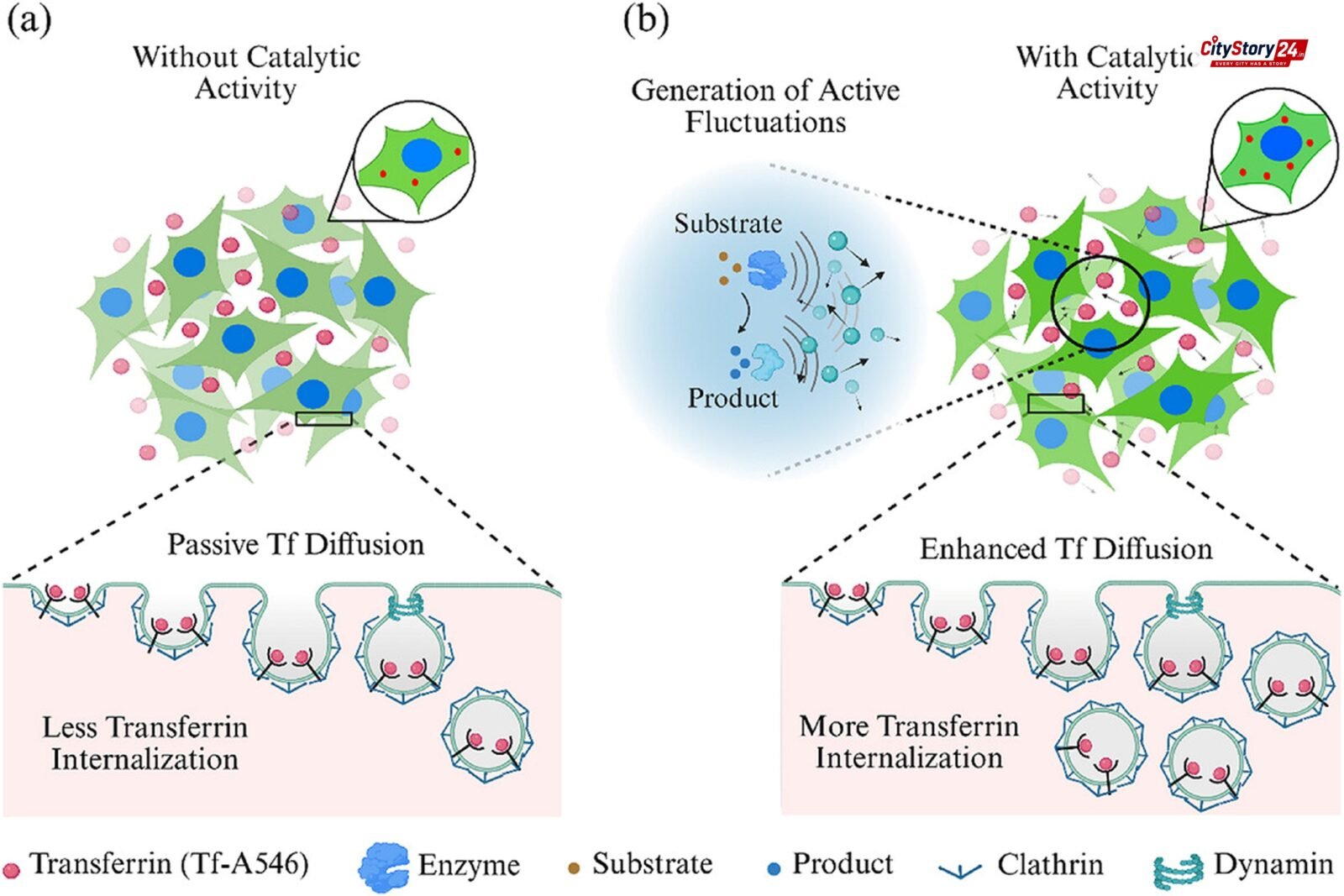
- Cells took up roughly 17 percent more transferrin when nearby enzymes were active
- Transferrin moved roughly 50 percent faster in the enzyme-active experiments
- Enzymes did not enter the cell or change the cargo
- Uptake gain levelled off because cells have a limited number of transferrin receptors
- Therapeutic applications are yet to be demonstrated, the lead researcher said
Enzymes in the fluid outside a cell can make it take in about 17 percent more transferrin, an IIT Gandhinagar-led study finds. The research was published in the journal Small.
The study was carried out by researchers from IIT Gandhinagar in Gujarat, working with IIT Jodhpur, IISER Kolkata and the University of Pennsylvania. It shows that a chemical reaction in the fluid around a cell can, on its own, change how much of a cargo the cell absorbs.
Dr Krishna Kanti Dey, corresponding author and Associate Professor at the Department of Physics, IITGN, said the enzymes work without entering the cell or changing the cargo. Transferrin is a protein the body uses to carry iron into cells.
How the team tested the effect
The researchers let cultured cells absorb fluorescently labelled transferrin, with and without nearby active enzymes. The dye acts as a tracer, showing both where the protein goes and how much the cell takes up.
Cells with working enzymes glowed brighter. Using Total Internal Reflection Fluorescence (TIRF) microscopy, the team found transferrin moved roughly 50 percent faster when the enzymes were active.
A second method, fluorescence correlation spectroscopy, showed a similar pattern. Transferrin diffusivity rose by about 40 percent with the urease enzyme and 44 percent with alkaline phosphatase.
A physical push, not a change inside the cell
Using optical tweezers, which hold tiny objects with a focused laser, the team measured mechanical fluctuations from the enzyme reactions. Both enzyme systems generated forces in the piconewton range during active catalysis.
Nividha, first author and PhD Scholar at IITGN’s Department of Physics, said the effect depended on active enzyme catalysis. The enzymes, their substrates or reaction products alone did not produce it.
The team then blocked dynamin, a protein needed for the final step of clathrin-mediated endocytosis, the main route by which the cell pulls in molecules. Some transferrin still entered through other routes, but the enzyme-driven boost disappeared. The effect works specifically through the clathrin-mediated route.
Why the gain levels off
Faster movement did not produce an equal rise in uptake. Transferrin moved about 50 percent faster, but uptake rose only about 17 percent.
A simple computer model linked the two. A cell has only a limited number of transferrin receptors. Once they are full, extra speed brings no more uptake. The team saw the same ceiling when it increased the amount of transferrin offered.
Possible use in drug delivery
Dr Dey said the findings could matter for controlling molecular transport, including delivering therapeutic cargoes across biological barriers. He cautioned that these uses still need testing, and that the present work shows the effect only in a controlled cellular system.
The work was supported by the Anusandhan National Research Foundation (ANRF), the Ministry of Education’s STARS scheme and the Gujarat State Biotechnology Mission.