
- Defence Minister Rajnath Singh launched FSS-1, named Surya, at Visakhapatnam
- Keel of the fifth Fleet Support Ship, FSS-5, was laid at the same event
- Upgraded Slipway-4 can now build and launch ships of up to 45,000 DWT
- 300-tonne Goliath Crane was designed and made under Make in India
- Singh urged Hindustan Shipyard to match global shipyards on quality and delivery
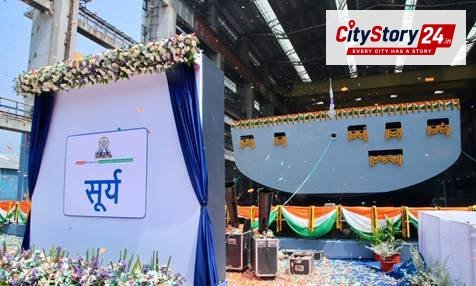
Defence Minister Rajnath Singh launched the first indigenous Fleet Support Ship, FSS-1, at Hindustan Shipyard Limited (HSL) in Visakhapatnam on October 06, 2026. He also laid the keel of the fifth Fleet Support Ship, FSS-5, and inaugurated an upgraded slipway and a new crane.
The three milestones will help HSL build larger and more complex ships. Singh said they also add to India’s indigenous maritime capability.
Speaking at the event, Singh said the launch showed achievement, the keel laying showed resolve, and the new slipway showed growing capability. He said HSL was building the base of India’s maritime power, not just its shipbuilding capacity.
Fleet Support Ships to extend Navy’s reach
Singh said the Fleet Support Ships will extend the Navy’s reach, endurance and operational effectiveness in the Indian Ocean Region. Ships operating far from home need logistics, maintenance and sustained support, not just warships.
The vessels will provide at-sea replenishment and support to naval operations. FSS-1, named Surya, was launched with traditional honours performed by Laila Swaminathan, President, Navy Wives Wellness Association (NWWA). After launch, it entered the waters of the Bay of Bengal to cheers from the gathering.
HSL designed and built the ships in India. They will carry more cargo and fluid, have first-line maintenance workshops on board, a helicopter deck for Multi-Role Helicopter operations and self-defence systems.
Bigger shipyard infrastructure
The upgraded Slipway-4 has been extended and strengthened. It will let HSL build and launch ships of up to 45,000 DWT.
The 300-tonne Goliath Crane spans Slipways 3 and 4. L&T Geostructure designed and made it with Konecranes under Make in India. It has PLC controls, variable frequency drives, tandem lifting, remote diagnostics and condition monitoring. It will handle heavier blocks faster and more precisely for modern block construction.
Visakhapatnam as a maritime hub
Singh said self-reliance is only a milestone. He said Indian shipyards must compete with the world’s leading yards on quality, cost, technology, delivery and reliability.
Self-reliance is an important milestone, but global competitiveness is the next big leap
He asked HSL to work more closely with Andhra Pradesh’s industry. He said MSMEs could become suppliers, universities could support research and skills, and startups could develop maritime technology.
Singh said the Eastern Naval Command, the Naval Dockyard, HSL and Visakhapatnam Port give the city a base for an integrated maritime ecosystem. He called for Visakhapatnam to become a major Maritime Industrial Hub. He also urged closer ties between the Navy, HSL, DRDO, academia, industry, MSMEs and startups.
He set out HSL’s priorities: timely delivery as a culture, learning from global shipyards, stronger indigenous design, partnerships with MSMEs and startups, and lifecycle capability. He also stressed closer coordination between the Navy and shipyards.
Admiral Krishna Swaminathan, Chief of the Naval Staff, Janardhan Reddy, Minister of Roads, Buildings, Infrastructure & Development, Government of Andhra Pradesh, and Sribharat Mathukumilli, Member of Parliament, Visakhapatnam, attended the event. Sanjeev Kumar, Secretary (Defence Production), and Vice Admiral Sanjay Bhalla, FoC-in-C, Eastern Naval Command, were also present.