
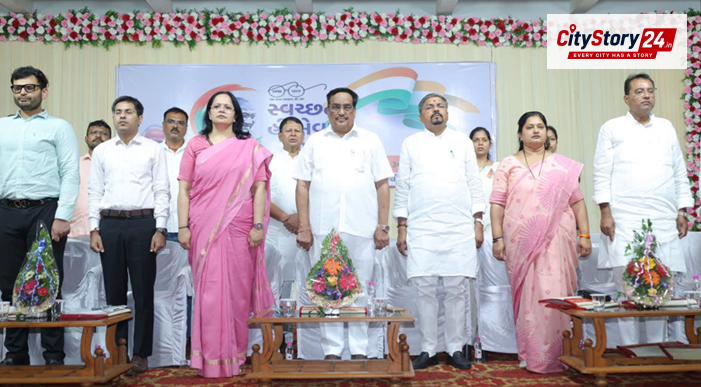
- Union Minister C. R. Patil attended the Special Gram Sabha at Majigam village, Navsari district, Gujarat.
- He felicitated sanitation workers and urged people to make cleanliness a daily habit.
- Gram Sabhas were held across rural India as part of Swachhata Hi Seva 2026.
- Participants took the Swachhata pledge and joined a plantation drive under 'Ek Ped Maa Ke Naam'.
Union Minister C. R. Patil took part in a Special Gram Sabha at Majigam village in Chikhli Block, Navsari district, Gujarat, on Swachh Bharat Diwas, 2 October 2026.
Naresh Patel, Cabinet Minister, Government of Gujarat, also attended. So did Aishvarya Singh, District Collector and District Development Officer, along with senior State and district officials.
Cleanliness as a daily habit
Patil felicitated sanitation workers. He said cleanliness should be a shared commitment, not a one-day campaign. It should become part of everyday life and behaviour.
He urged people not to litter and to stop others from doing so.
In his address, Patil recalled Mahatma Gandhi’s emphasis on cleanliness alongside freedom. He said the biggest post-Independence push for sanitation had come under Prime Minister Narendra Modi. He pointed to the Swachh Bharat Mission as a nationwide people’s movement that had transformed rural sanitation.
Waste management and new framework
Discussions covered the achievements of Swachhata Hi Seva 2026, the Solid Waste Management Rules, 2026, and Swachh Seva Aankalan. The last is an annual digital self-assessment framework for Gram Panchayats, presented by the Joint Secretary and Mission Director of the Swachh Bharat Mission (Grameen).
Patil had earlier visited a “Waste to Art” exhibit in the Gram Panchayat. It showed creative reuse of discarded materials.
Patil and the Joint Secretary and Mission Director planted trees under ‘Ek Ped Maa Ke Naam’. All dignitaries and participants then took the Swachhata pledge.
Special Gram Sabhas across the country
Special Gram Sabhas were held across rural India on 2 October 2026 under Swachhata Hi Seva 2026. They reviewed local sanitation and waste management, and checked the status of four-way source segregation. They also identified and registered bulk waste generators.
The sessions helped Gram Panchayats carry out gap assessments. They also fed actions into Gram Panchayat Development Plans, including GPDPs, for grassroots implementation.
Senior officials from the Department of Drinking Water and Sanitation (DDWS) joined sessions in several States and Union Territories:
- Dadra and Nagar Haveli: Deputy Secretary, DDWS, attended the session at Sayli Gram Panchayat. It covered the Swachhata Shapath and the felicitation of sanitation workers. Participants also visited a sewage treatment plant and joined a plantation drive.
- Jharkhand: Deputy Secretary, DDWS, attended the session at Pindarkom village, Sithiyo Gram Panchayat, Namkum Block, Ranchi district. Discussions included the draft Swachh Seva Aankalan and the closing of identified gaps. The programme also covered an inspection of sanitation assets.
- Haryana: Deputy Secretary, DDWS, attended the session at Ratipur village, Palwal Block, Palwal district. The visit included a plantation drive and an inspection of the segregation shed.
- Madhya Pradesh: Assistant Adviser, DDWS, attended sessions at Mugaliya Haat and Jhirniya Gram Panchayats, Phanda Block, Bhopal district. Participants took the Swachhata Shapath and inspected a segregation shed.