
- Two-wheelers are the main mode for 42.6% of workers reaching fixed workplaces
- 57.6% of workers make trips of more than 1 km within a travel day
- 83.4% of workers reach their fixed workplace in under 30 minutes
- Buses (55.8%) and railways (17.7%) carry most household overnight journeys
- Average monthly commuting cost is ₹785 for workers and ₹443 for students
Two-wheelers are the main way 42.6% of workers reach fixed workplaces, the first national household travel survey shows.
Workers in Gujarat, Rajasthan and Madhya Pradesh average travel times of around 20 to 23 minutes, the survey found. Higher times were recorded in parts of southern India.
The National Statistics Office (NSO), under the Ministry of Statistics and Programme Implementation (MoSPI), released the findings through a factsheet. The survey ran from July 2025 to June 2026. For its purpose, a trip means travel covering more than 1 km.
The survey covered 14,274 villages and 10,377 urban blocks. It collected information from 4,92,023 households, covering 20,34,371 persons.
Workers: two-wheelers and a wide gender gap
Over half of workers aged 15 and above make trips of more than 1 km to work. The share is 57.6% overall, at 64.1% in urban areas and 54.5% in rural areas.
Male workers record 61.9% for daily work trips, against 41.9% for female workers. Two-wheelers are the single largest primary mode, at 37.1% in rural areas and 52.3% in urban areas.
Monorail, metro, suburban rail and trams carry 5.0% of urban worker commutes nationally. The share is higher in Maharashtra (20.7%), West Bengal (16.5%) and Delhi (14.4%).
Most workers travel briefly. 83.4% reach their fixed workplace in under 30 minutes, and 94.9% leave before 10:00 AM.
Students: walking and buses lead
66.4% of students aged 6 and above make trips of at least 1 km to attend their educational institutions. The share is 68.1% in urban areas and 65.6% in rural areas.
Walking (37.0%), buses (29.5%) and bicycles (15.8%) are the top three modes for school trips. Auto-rickshaws serve 10.5% of commuting students, rising to 14.4% in urban areas.
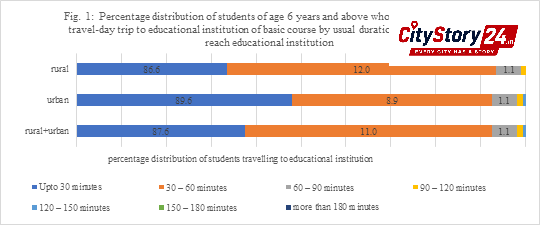
87.6% of students reach their institutions within 30 minutes. Most students leave between 7:00 AM and 10:00 AM, and 35.7% leave between 8:00 and 9:00 AM.
Commuting costs
An average worker spends ₹785 a month on commuting to a fixed workplace. Urban workers spend ₹1,044 a month, while rural workers spend ₹612.
Male workers spend an average of ₹835 a month, against ₹533 for female workers. Students spend an average of ₹443 a month, with urban students spending ₹617 and rural students ₹361.
Overnight trips
Buses (55.8%) and inter-city railways (17.7%) are the main modes for household overnight travel. Cars account for 15.1% and two-wheelers for 8.8%.
Railways are used more in cities. About 22.7% of urban households take rail for overnight trips, against 14.0% of rural households.
Socialising, communication and religious activities drive 70.2% of overnight household trips. Culture, leisure, sports and tourism account for 7.4%.
The NSO said the data will help identify gaps in transport systems, assess accessibility and optimise routes. It will also guide service frequency, scheduling and transport investment.