
Source: Press Information Bureau (PIB), Government of India — Ministry of Electronics and IT · PIB Delhi · Read the original release on pib.gov.in
- The report presents a framework for developing economies to use Artificial Intelligence for development through adoption, adaptation and scaling up
- IndiaAI Mission, Ministry of Electronics and Information Technology and the World Bank Group jointly hosted this launch event in India; Policymakers, development experts and technology leaders deliberate on scaling up Artificial Intelligence for inclusive growth
- High-level panel and state-level AI expo explore how India can move from isolated AI pilot projects to evidence-based scale-up
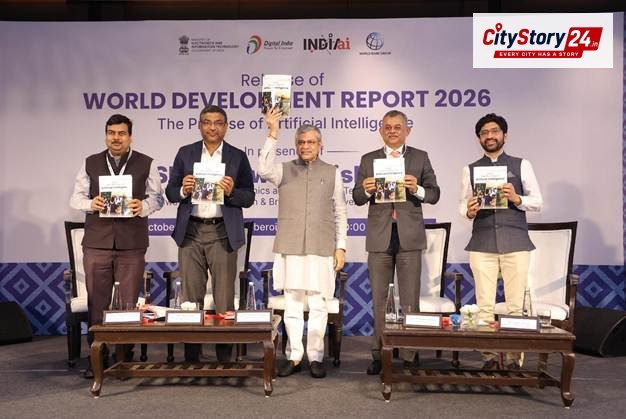
Union Minister of Electronics & Information Technology, Railways and Information & Broadcasting, Shri Ashwini Vaishnav released the World Bank Group's World Development Report 2026: The Promise of Artificial Intelligence at an event held at Oberoi Hotel, New Delhi today. The report analyzes the opportunities and challenges presented by Artificial Intelligence (AI) for developing economies and offers a framework for countries to use it for development through adopting, adapting and scaling up AI.
The program was launched by the IndiaAI Mission of the Ministry of Electronics and Information Technology (MeitY), Government of India, in collaboration with the World Bank Group. It brought together senior policymakers, global development experts, technology leaders and experts to deliberate on how India can maximize and safely sustain the development benefits derived from the AI Mission. The program also included a state-level AI showcase, in which states and innovators from across the country presented AI-enabled solutions.
The report says AI can expand access to expertise, increase productivity and improve the quality of services in developing economies. AI-enabled tools are already being used in medical diagnosis, agricultural decision making, and education, bringing scarce expertise to larger segments of the population. The report also emphasizes that these gains rest on strong foundations, including reliable electricity and connectivity, computing infrastructure, quality data, skills, education systems and capable institutions.
Union Minister of Electronics and Information Technology Shri Ashwini Vaishnav delivered the keynote address and formally presented the report. The Union Minister emphasized India's vision to democratize technology, so that the benefits of Artificial Intelligence can reach citizens, enterprises and institutions across the country.
Mr Ashwini Vaishnav said, "AI is changing the lives of common people. In Baramati, farmers who had never used a computer recorded a 40 per cent increase in sugarcane yield just by using voice on the phone, while water and fertilizer consumption reduced by 30 per cent. In healthcare, TB detection rates have increased by 35 per cent. Such examples can change the lives of people in developing countries and across the world."
The Union Minister said that the Baramati initiative has used satellite, IoT and meteorological data and has also reduced labor costs. In Gujarat, AgriStack is being used by 5 lakh farmers, and the use of AI for animal health through Saralaben is benefiting 3 crore animals and their farmers.
India has emerged as an important ecosystem for the development and use of AI, with applications in healthcare, agriculture, education, good governance, financial services and other areas of public and economic importance. The Government of India is building a comprehensive AI ecosystem through the IndiaAI Mission on seven pillars: IndiaAI Computing Capacity, IndiaAI Innovation Center for Indigenous Grounded Models, IndiaAI Dataset Platform (AICOSH), IndiaAI Application Development Initiative, IndiaAI FutureSkills, IndiaAI Startup Funding and Safe and Secure AI.
The mission aims to strengthen India's capabilities across the AI value chain, while also ensuring that AI development remains inclusive, responsible and suited to India's vast size, diversity and multilingual context. The government's vision is focused on democratizing access to computing, data and models, addressing India-specific challenges, and creating economic and employment opportunities. Under the Safe and Trusted AI pillar, the government is supporting the development of indigenous tools and frameworks for responsible AI, including AI bias mitigation, algorithmic auditing, explainable AI, privacy-preserving AI and deepfake detection and put in place institutional mechanisms for AI good governance and security.
The launch of this initiative in India provided a platform for policymakers and experts to examine how successful AI pilot projects can be identified, evaluated and scaled up to achieve measurable development outcomes and how to guard against the risks posed by AI.
The program began with welcome speeches by Mr. Sudeep Srivastava, Chief Operating Officer, IndiaAI Mission and Joint Secretary, Ministry of Electronics and Information Technology and Dr. Somik Lal, Director, Development Economics and Strategy, World Bank Group.
Dr. Somik Lal said, "A key message of the World Development Report is not about the creation of Artificial Intelligence, but about its use. India has a unique opportunity to transform the lives of millions of people by bringing together institutions, markets and AI."
Dr. Michael Cramer, Chief Economist and Senior Vice President, World Bank Group, delivering the keynote address “From AI Pilot Projects to Scale-up: The Promise of AI in India”, highlighted that India’s progress in AI has lessons for the wider developing world. “India’s huge progress in AI is not only solving its own problems, but also broader development challenges for the world,” he said.
Citing examples of weather advisories and edtech solutions for farmers in Andhra Pradesh, he said, “For widespread adoption of AI solutions, we need a holistic approach, not just the software element but also the human and institutional element associated with it.”
Dr. Kramer presented India's AI-based monsoon forecast as an example for the world. The Government of India, through its meteorological agencies and the Ministry of Agriculture, tested and combined multiple AI models, including openly available models, and provided forecasts to millions of farmers through text, voice and AI-powered advisories. This model had predicted abnormal monsoon of the year 2025 and now Ethiopia is also following India. He said this case shows that where business incentives are weak but social potential is high, government has an important role to play.
After this, Dr. Gaurav Nayyar, Director of the World Development Report 2026, presented the major findings of the report.
Dr. Nayyar said, “India is already on the path of Artificial Intelligence (AI) for development, with tools adapted to local conditions and the government playing the role of promoter, user and regulator of this new technology. AI can solve problems in decades for developing countries like India, which could not be solved in a century.”
The presentation presented the report's key messages for developing countries: Be Optimistic, Be Strategic and Be Pragmatic. Countries must adopt and transform AI, then progress; Instead of spending billions of dollars to build advanced systems, the focus should be on adapting AI tools to local conditions; And we as promoters, users and regulators of AI must make cost-conscious choices. It also noted that the threat of employment disruption is not as imminent in developing countries, and that the countries most likely to benefit from AI are perhaps the least prepared, as only one in 25 low-income countries in the world has published a national AI strategy.
Shri Neelkanth Mishra, Executive Director, World Bank Group and Shri S., Secretary, Ministry of Electronics and Information Technology. Krishnan specifically addressed.
Shri S. “The World Development Report aligns perfectly with India’s AI framework (computing, data and models) and offers a pragmatic approach to regulation: relying on existing laws and voluntary compliance and reviewing regulation as the technology evolves,” Krishnan said.
Shri Krishnan said that human capabilities matter most and in line with the Prime Minister's vision, work on AI Talent Mission is underway. He said that being one of the countries with the highest prevalence of AI skills in the world, India can support developing countries, while domestically AI adoption should expand at the enterprise level and the government should remain agile and adaptive.
This was followed by a high-level panel discussion on “Using AI for Development in India”. It considered three questions: the challenges of AI adoption in India, how India can leverage AI and adapt it to local contexts and needs, and the policies needed to control the risks posed by AI. The discussion emphasized that realizing the benefits of Artificial Intelligence will require policies that ensure that its benefits are widely shared and its risks are tightly controlled.
The panel included Mr. Neelkanth Mishra, Executive Director, World Bank Group, Dr. Somik Lal, Director of Development Economics Strategy, World Bank Group, Dr. Vivek Raghavan, Co-Founder of Sarvam AI, Dr. Neeraj Aggarwal, Chief Program Officer of Wadhwani AI, Mr. Manish Singh, Vice President, BharatGen and Mr. Shankar Maruwada, Co-Founder and CEO, Ekstep Foundation. The session was moderated by Ms. Shereen Bhan, Managing Editor, CNBC-TV18. Panelists stressed the need to go beyond a few pilot projects to evidence-based scale-up, strengthen local capacities, improve access to data and computing, establish appropriate institutional frameworks, and keep AI solutions relevant to India's diverse social and economic context.
The panel discussion was followed by a State AI showcase on the theme “AI Innovations from across India”, which showcased from a pan-India perspective how states are using scalable AI applications across sectors to address local and development challenges. Each presenter highlighted a leading AI-enabled solution, its implementation process, and its measurable impact. The presentations were as follows:
- new consciousness, An AI-enabled early screening initiative to detect developmental delays in children aged 0 to 6 years was presented. It was presented by Shri M. Venugopal Reddy, Director, Women Development and Child Welfare Department, Andhra Pradesh;
- Mahavistaar AI, A connected platform for personalized advice, digital services and farmer engagement was presented. It was presented by Mr. Faheem Sheikh of POCRA Project, Maharashtra;
- adskgrid, A GeoAI Governance Intelligence solution for education was presented by Ms. Richa Kulkarni, State Project Director, Samagra Shiksha Abhiyan and Director of School Education and Literacy, Meghalaya;
- array–servii, A Cervical Cancer Screening Solution for Point of Care was presented by Mr. Dhritiman Mallick, Co-Founder and CEO of Vyuha Med Data, winner of the NCG CATCH Grant;
The exhibition highlighted diverse approaches, emerging models and solutions that have the potential to adapt across geographies.
The discussions stressed the importance of increasing public trust in AI and ensuring that the technology is developed in a safe, responsible and inclusive manner. India's launch of the World Development Report 2026: The Promise of Artificial Intelligence plays an important role in the global dialogue on using AI as an enabler of development and highlights the need for countries to build the foundational capacities, institutions and policy frameworks needed to translate advances in AI into broader and sustainable development outcomes.
The program was concluded by Shri Mohammad Y. Safirullah K., IAS, Director, IndiaAI with the concluding speech of the mission.
This is the official press release issued by the Press Information Bureau (PIB), and is published without changes.