

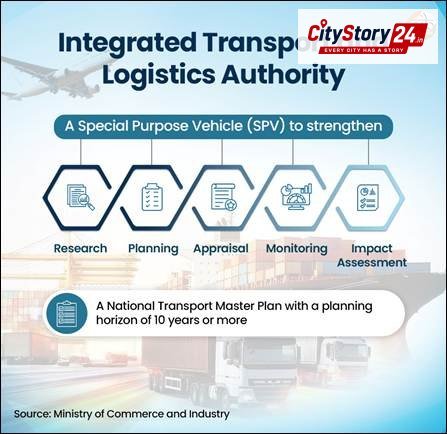
- Government approved the Integrated Transport & Logistics Authority on 6 October 2026
- ITLA will prepare a National Transport Master Plan with a horizon of 10 years or more
- Technical appraisal covers central projects costing ₹500 crore or more
- Projects above ₹500 crore will be monitored, with post-completion impact assessments
- A National Transport Data Repository will draw on FASTag, e-way bills and Vahan data
The government has approved a new Integrated Transport & Logistics Authority (ITLA) to plan, appraise and monitor India’s transport and logistics projects.
The authority will act as a specialised body for research, planning, project appraisal, monitoring and impact assessment. It will support long-term planning and check how infrastructure projects perform after completion. It will work alongside the PM GatiShakti National Master Plan and the National Logistics Policy.
Planning and monitoring role
- It will act as the top institution for transport and logistics planning, research, appraisal and monitoring, backed by policy support and data analytics.
- It will draw up the National Transport Master Plan with a horizon of 10 years or more. The plan will span urban mobility, logistics, coastal shipping, inland waterways, civil aviation, ports, railways and roads.
- It will review five-year sectoral plans and the annual plans of transport ministries. It will ensure they fit the master plan and encourage multimodal infrastructure.
- It will carry out technical appraisal of central infrastructure projects costing ₹500 crore or more. Financial appraisal will stay with existing mechanisms.
- It will monitor projects above ₹500 crore, resolve issues through a coordinated mechanism, and assess outcomes after completion.
Data, skills and research
The authority will build a National Transport Data Repository. It will combine datasets from GSTN e-way bills, FASTag, Vahan, GPS-based systems and urban traffic management systems. The data will help analyse freight flows and origin-destination patterns for planning and monitoring.
It will also advise on reviewing and updating the National Logistics Policy (2022). In addition, it will support capacity building, training and skilling in logistics, and promote research and innovation.
Coordination and global practice
The approach follows global practice, in line with countries such as Korea, Japan, the US, China and Australia. The authority will coordinate among ministries dealing with transport and logistics, from planning to evaluation.
It will also strengthen skills in big data integration and promote international best practices.
Link to Vision 2047
The government says the authority will improve infrastructure efficiency and multimodal connectivity. It will contribute to India’s Vision 2047 and a more competitive logistics sector.