

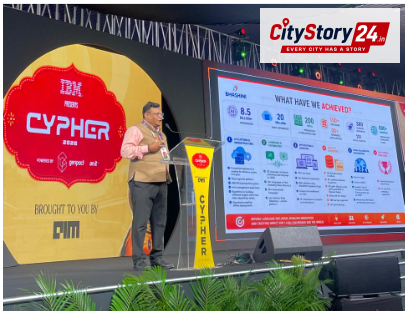
- Amitabh Nag, CEO of Digital India BHASHINI Division, spoke at Cypher 2026
- A live demo translated and transcribed spoken proceedings into Kannada in real time
- BHASHINI works with low-resource languages such as Bhili
- Platform supports 36 Indian languages in text and 23 in voice
- Over 9 billion cumulative AI inferences recorded so far
The Digital India BHASHINI Division used a conference on artificial intelligence to show how language tools work at scale. Its CEO, Amitabh Nag, led a session at Cypher 2026, and a live demo produced Kannada translation in real time.
Live demo at the session
The session was titled ‘From AI Models to Real-World Impact: Building AI That Works at Population Scale’. Nag spoke about India’s experience of deploying language technology across a large population.
During the session, BHASHINI’s Shrutlekh provided live multilingual translation and transcription of the spoken proceedings into Kannada. The demo showed how language AI can support communication in a live setting.
Ecosystem and low-resource languages
Nag said that scaling AI needs more than individual models. He called for an ecosystem of language datasets, AI models, APIs and applications that departments, developers and institutions can use.
BHASHINI is also extending its work to low-resource languages, such as Bhili. The aim is to bring digital information to communities whose languages have limited presence in technology.
The platform has more than 350 AI-based language models, over 100 use cases and 30+ reference applications. Its open infrastructure lets developers and startups reuse language resources, models and APIs.
Working with partners
Nag said BHASHINI works with government departments and institutions to identify needs and adapt language tools. These partnerships cover healthcare, education, BFSI, legal assistance and grievance redressal.
BHASHINI-enabled technologies are integrated across 2,353 government platforms, including more than 800 government websites. The platform supports 36 Indian languages in text, 23 in voice and 35 international languages.
It has enabled more than 9 billion cumulative AI inferences, with over 24 million daily.