
इस खबर का हिंदी अनुवाद तैयार किया जा रहा है। यह पेज कुछ ही क्षणों में अपने आप हिंदी में खुल जाएगा।
- 34 of 36 States/UTs have issued orders directing local bodies to follow RoW Rules, 2024
- RoW timelines: 67 days for general applications, 7 days for Special Projects like BharatNet
- SASCI 2026-27 earmarks ₹4,000 crore to help states implement RoW reforms
- As of August 2026, 28,700 Gram Panchayats were upgraded and connected under ABP
- Samriddh Gram model won a WSIS Prizes 2026 award under Action Line C6
Centre and States pledged faster telecom rollout at a DoT roundtable, where 25,367 mobile towers were reported commissioned by August 31.
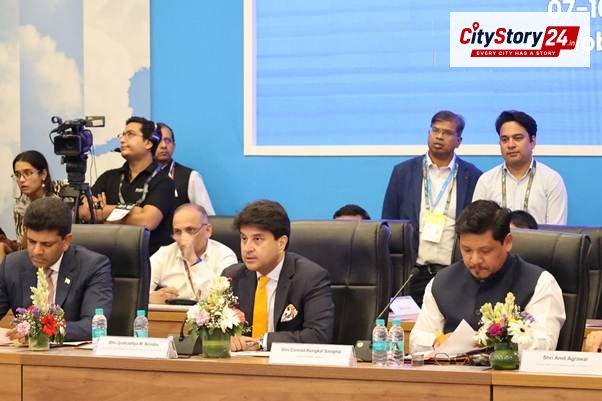
The Department of Telecommunications held the meeting with state IT ministers and secretaries on the sidelines of India Mobile Congress 2026. Union Minister Jyotiraditya M. Scindia chaired it, with Minister of State Chandra Sekhar Pemmasani and DoT Secretary Amit Agrawal. The theme was “Scale Without Boundaries”.
Faster right of way approvals
Officials focused on right of way (RoW), land and site access, which states and UTs control on the ground. The Telecommunication (Right of Way) Rules, 2024, have applied since January 1, 2025. They set uniform charges and time limits.
The rules allow 67 days for general RoW applications and 7 days for Special Projects such as BharatNet. Thirty-four States/UTs have issued orders asking local bodies and line departments to follow them. All 36 States/UTs are now live on the Central RoW Portal.
The Special Assistance for Capital Investment (SASCI) Scheme 2026-27 has ₹4,000 crore earmarked. It is meant to help states, their PSUs, corporations and urban local bodies carry out RoW reforms.
BharatNet and 4G reach
The meeting reviewed the Amended BharatNet Programme (ABP), which upgrades the existing network and adds links for new Gram Panchayats. It also aims to connect non-GP villages on demand and provide 1.5 crore fibre internet connections.
As of August 2026, 55,780 km of optical fibre cable had been laid. Under ABP, 28,700 Gram Panchayats had been upgraded and connected.
Projects funded by the Digital Bharat Nidhi are bringing mobile coverage to remote areas that operators had skipped for commercial reasons. As of August 31, 2026, 25,367 mobile towers had been commissioned, covering 35,771 villages and locations. BSNL is using the indigenous 4G stack in its 4G Saturation Project.
Cyber safety and Samriddh Gram
Participants discussed closer coordination between the DoT, states, law enforcement agencies and telecom operators to fight cybercrime and financial fraud. The Sanchar Saathi portal lets citizens report suspected fraudulent calls, check mobile connections issued in their name, and block or trace lost phones. The Digital Intelligence Platform is used to share intelligence and act against cyber fraud.
The Samriddh Gram Phygital Services Initiative brings tele-consultations, digital classrooms, e-governance, banking, soil testing, drone services and e-commerce to rural areas through Samriddhi Kendras. It is being piloted in Umri in Madhya Pradesh, Chaurawala in Uttar Pradesh and Narakoduru in Andhra Pradesh. It has won the WSIS Prizes 2026 under Action Line C6.
The roundtable ended with a shared commitment from the Centre, States, UTs and the telecom industry to speed up infrastructure and adopt new technologies.