
- India aims for at least 10% of global 6G patents and standards
- About 136 R&D projects worth roughly ₹500 crore funded under TTDF
- Pemmasani wants 10 to 20 imported network technologies replaced with Indian alternatives
- C-DOT asked to start real operator trials of quantum communications
- Most rules under the Telecommunications Act, 2023 are now notified
India plans to secure at least 10% of global 6G patents and standards, Union Minister of State Dr Chandra Sekhar Pemmasani said today.
Telecom gains over five years
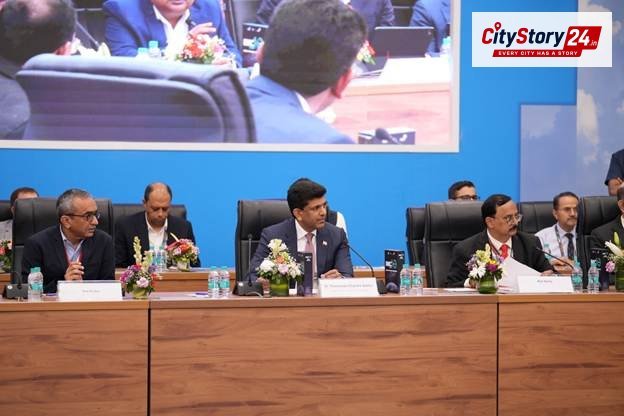
Speaking at a CTO round table on 6G infrastructure, held on the sidelines of IMC 2026, Union Minister of State for Communications and Rural Development Dr Chandra Sekhar Pemmasani reviewed the sector’s progress. He said more than a billion people are now connected.
Every district has 5G, supported by close to 5.6 lakh Base Transceiver Stations (BTS). Villages have 4G, and India has built its own indigenous 4G stack. Pemmasani thanked industry players for making this possible.
New rules and rural connectivity
Most rules under the Telecommunications Act, 2023 have now been notified, Pemmasani said. The aim is a simpler regulatory framework that is technology-neutral and suited to today’s technology needs.
He also pointed to the BharatNet and 4G saturation projects, which aim to bring high-speed fibre and connectivity to every village and home.
About 136 R&D projects, worth roughly ₹500 crore, have received funding from the Telecom Technology Development Fund (TTDF). They cover 5G, 6G, quantum communications, non-terrestrial networks, advanced optical systems, indigenous core networks and telecom security. He also flagged 5G testbeds in academic institutions, where students, researchers and startups can experiment.
Priorities: local supply, 6G, quantum and AI
Pemmasani urged the industry to identify 10 to 20 critical network technologies that India still imports. He wants Indian alternatives developed, especially in component manufacturing, chipsets, radios, routers and optical systems.
On 6G, he asked major operators to set measurable annual and quarterly targets. These should cover contributions to standards, standard-essential patents (SEPs), university research and industry collaboration.
On quantum communications, he asked C-DOT to begin real operator trials. These should include quantum-safe encryption on critical links and Quantum Key Distribution (QKD) where it makes economic sense, so the technology moves beyond laboratories.
He also called for a shift from AI-assisted to AI-native networks. He stressed national security, equipment and supply-chain security, fraud prevention and protection of critical telecom infrastructure.
He urged government, operators, equipment makers and technology firms to work closely together. He invited industry to submit wish lists, especially on areas needing simpler processes and policy changes to keep pace with technology.
“The last decade was Digital India. Our goal is to make the next decade an Intelligent India,” said Dr Chandra Sekhar Pemmasani.