

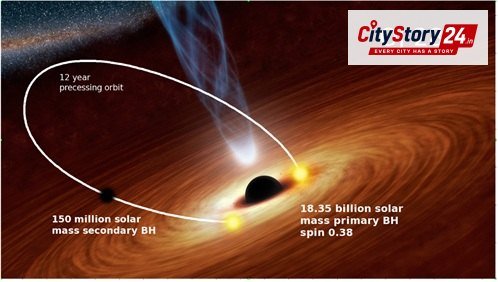
- OJ 287 is about 4 billion light years from Earth and holds two supermassive black holes
- The pair orbits each other in a twelve-year cycle, producing a double-peaked brightness pattern
- 106 scientists from 18 countries and 48 institutions took part
- The data is the densest optical record of OJ 287 in 150 years
- Central black hole mass estimated at at least 3.89 billion solar masses
Astronomers have tracked the changing brightness and colour of the blazar OJ 287 over a decade. The work adds new detail on its powerful emission and on its two central black holes.
A rare pair at the heart of a blazar
OJ 287 lies about 4 billion light years from Earth. Two supermassive black holes sit at its centre and orbit each other every twelve years, forming a binary system.
Supermassive black holes can weigh from millions to billions of times the mass of the Sun. OJ 287 is a blazar, which fires powerful jets of plasma almost at the speed of light towards Earth. Its emission runs from radio waves to gamma rays.
A team of Finnish scientists found the object’s double-peaked brightness pattern in 1988. They used nearly 100 years of optical observations, going back to 1880. Astronomers worldwide have kept watching it since then.
Decade-long campaign
Aryabhatta Research Institute of Observational Sciences (ARIES), Nainital, co-ordinated the study. ARIES is an autonomous institution of the Department of Science and Technology (DST).
Dr. Alok C. Gupta of ARIES led the study. It drew 106 scientists from 18 countries and 48 research institutions and universities. Together they used two dozen telescopes between 2015 and 2025.
The team captured the latest 12-year cycle of optical outbursts, from 2015 to 2019. Support came from ground-based and space-based telescopes working in other parts of the electromagnetic spectrum.
The campaign produced the most extensive and densely sampled optical time-series data on OJ 287 in 150 years. It also offers one of the widest multiband optical datasets available for the object.
What the data shows
The observations tracked changes over years and also rapid shifts over much shorter periods. Researchers used the data to pin down the positions of the two black holes at different times.
They also studied how the object’s brightness, spectrum and polarisation changed. The team searched for signs of emission from the smaller black hole.
Using eight optical spectra taken at Steward Observatory, USA, between 21 October and 22 November 2017, the team estimated the central black hole’s mass. It is at least 3.89 billion solar masses, based on the width of the [O III] emission line.
The study also looked at how the system emits light. It points to the value of multimessenger astronomy, which combines light, gravitational waves, neutrinos and cosmic rays from the same source. The findings take the research on OJ 287 beyond its binary nature.
What comes next
Researchers say continued monitoring across different wavelengths could help. It may improve understanding of relativistic jets, supermassive binary black holes and possible links between electromagnetic and gravitational-wave signals.